Local layer orientation
Changing deposition direction according to part geometry rather than using one global build direction.
Exploring deposition strategies in which layer orientation becomes a manufacturing variable.
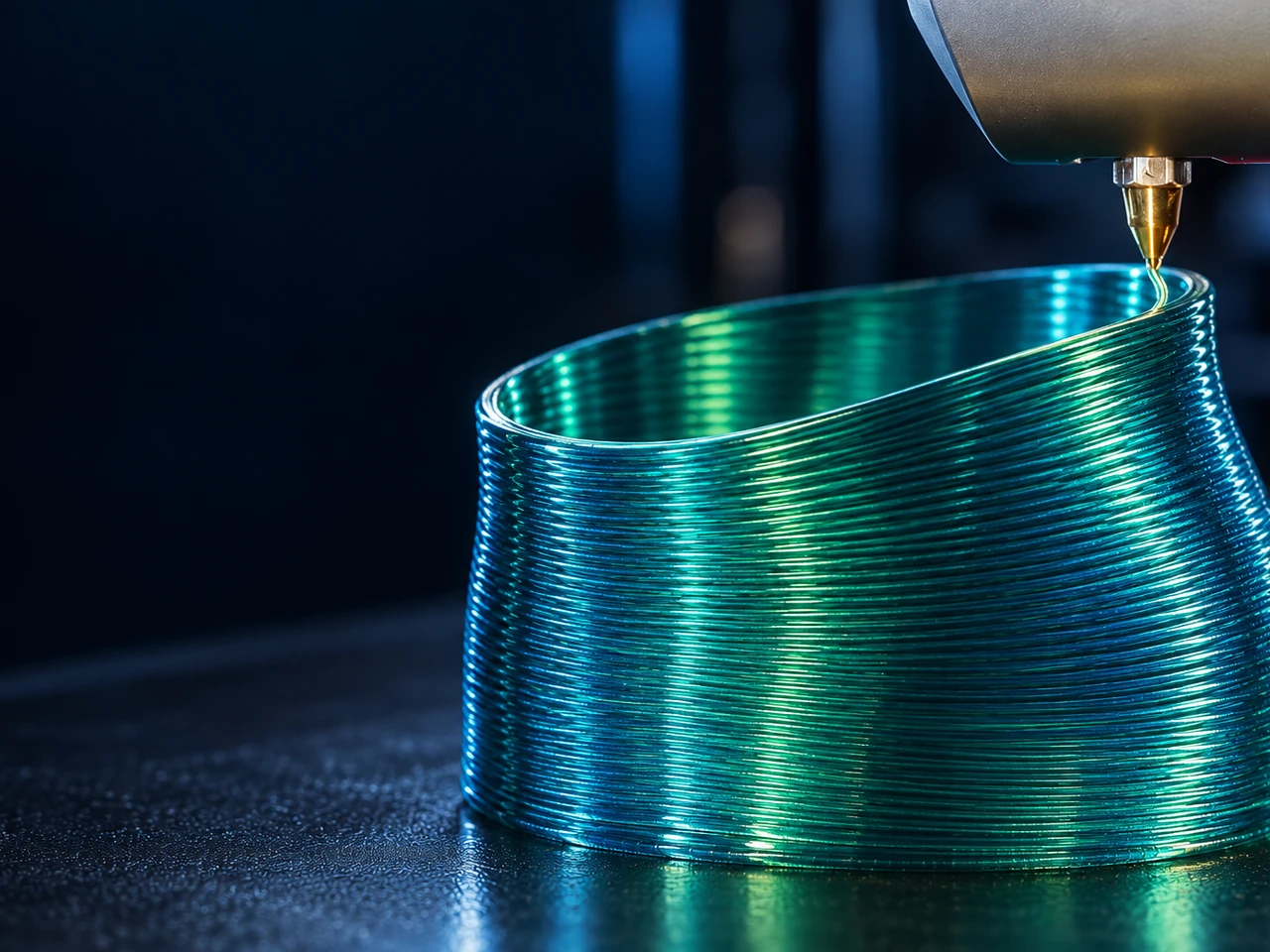
MYCNC3D experimentally investigates non-planar and multiplanar deposition methods intended to increase geometric freedom and reduce the constraints imposed by globally planar slicing.
Project overview
Physical non-planar printing has been demonstrated on representative FDM hardware.
MYCNC3D is investigating deposition strategies in which layer orientation becomes a manufacturing variable rather than a fixed global constraint. The research focuses on local deposition orientation, inclined and curved trajectories, overhang capability, surface continuity and the physical clearance limits imposed by the nozzle and toolhead geometry.
A mathematically valid trajectory is not necessarily manufacturable. For this reason, generated paths are evaluated through physical printing experiments to determine practical limits related to slope, curvature, extrusion stability and machine clearance.
Current experimental work focuses on extending successful demonstrations into repeatable and reusable manufacturing strategies.
Why it matters
A mathematically valid non-planar path can still be impossible to manufacture because of toolhead interference, insufficient nozzle clearance, excessive local slope or unsuitable extrusion conditions.
The research therefore combines geometry with manufacturability.
Current focus
Changing deposition direction according to part geometry rather than using one global build direction.
Evaluating how inclined or curved deposition paths alter support requirements and accessible geometry.
Studying continuous paths that follow a surface rather than a stepped planar approximation.
Determining practical limits imposed by nozzle, heater block and toolhead geometry.
Identifying path geometries that remain printable with stable material deposition.
Comparing generated trajectories with real printed results.
Engineering approach
The research cycle combines geometry generation, path inspection, machine preparation and controlled printing tests. Results are used to refine clearance rules, slope limits and deposition strategies.
Current status
Physical non-planar printing has been demonstrated. The current phase is focused on converting successful physical demonstrations into repeatable and reusable manufacturing rules.
Next milestone
The next milestone is to establish repeatable path-generation and machine-clearance rules that can be applied across multiple geometries rather than individual test parts.
Progress toward UNDER DEVELOPMENT will require defined limits for slope, curvature and tool clearance, together with reduced manual correction and repeatable physical results.
Integrated platform
Non-planar manufacturing sits directly at the intersection of toolpath generation, machine kinematics and material deposition. It is a key experimental bridge between the three MYCNC3D technology pillars.
Collaboration
MYCNC3D is interested in exchanges with researchers, software developers, machine manufacturers and industrial users exploring non-planar or multiplanar additive manufacturing.