Parametric path generation
Reusable path families from explicit geometric and process parameters.
Generating manufacturing motion directly from process intent rather than relying only on conventional planar slicing.
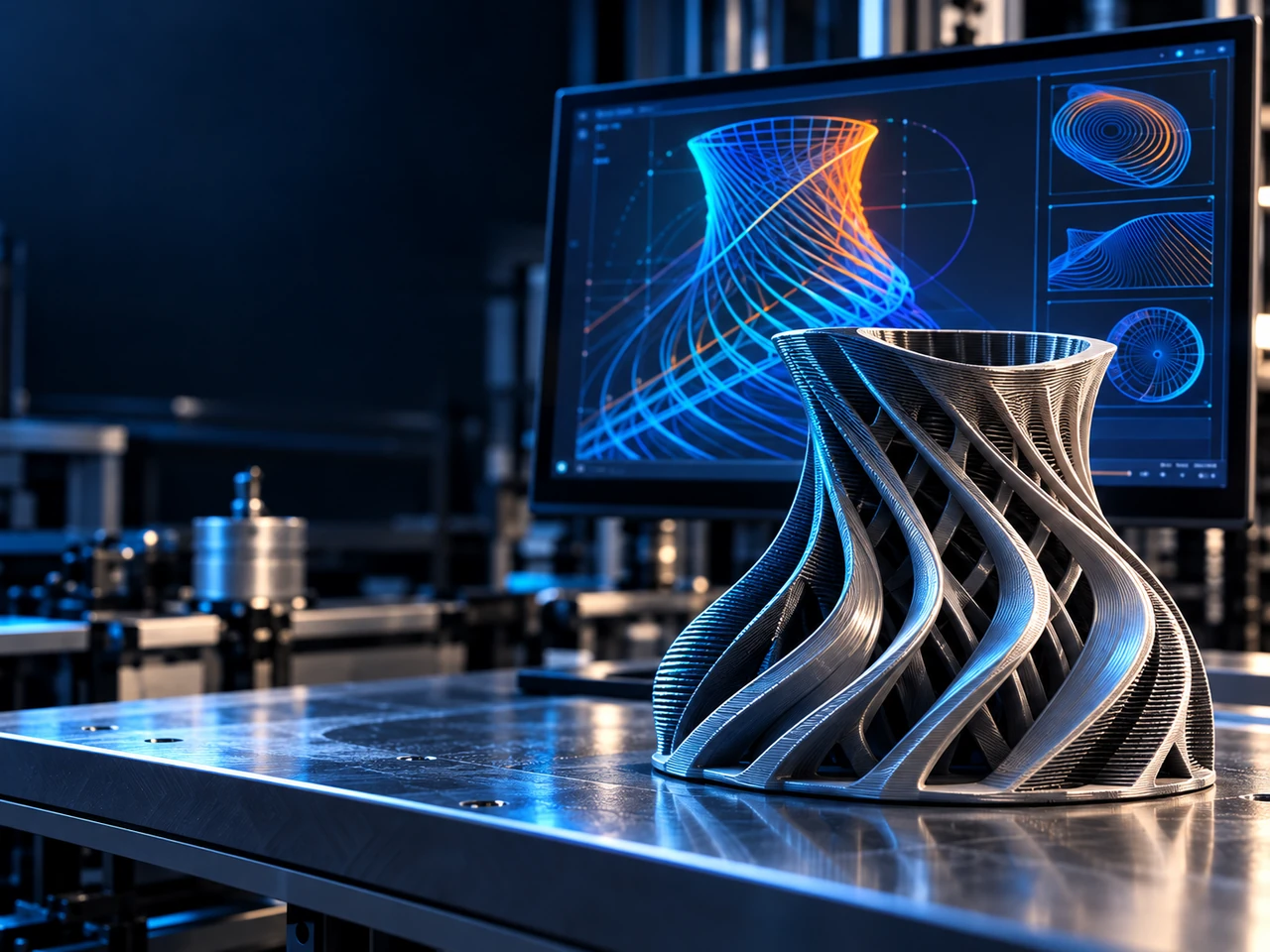
MYCNC3D develops experimental methods for generating toolpaths and machine motion adapted to unconventional FDM processes, including variable deposition geometry, non-planar trajectories and flow-aware speed control.
Project overview
Multiple families of generated toolpaths have been physically printed and evaluated.
MYCNC3D develops experimental methods for generating additive-manufacturing trajectories directly from geometric and process parameters. Research includes parametric path generation, variable deposition geometry, non-planar trajectories, path ordering, motion continuity, machine-specific post-processing and flow-aware speed control.
A geometrically correct path is not automatically a reliable manufacturing path. Extrusion demand, acceleration, intersections, local bead geometry, continuity and machine constraints must all be considered during trajectory generation.
Current research focuses on converting successful geometry-specific methods into reusable and parameterised trajectory-generation components.
Why it matters
A geometrically valid path is not automatically a good manufacturing path. Extrusion throughput, acceleration, local bead geometry, intersections, continuity and machine kinematics all affect whether the motion can be executed reliably.
Toolpath generation must therefore connect geometry with physical process limits.
Current focus
Reusable path families from explicit geometric and process parameters.
Local control of bead width, height or path shape.
Adapting machine speed to local extrusion demand and volumetric-flow limits.
Generating curved or inclined paths beyond planar layer assumptions.
Reducing unnecessary travel, intersections and discontinuities.
Converting generic manufacturing intent into commands compatible with target kinematics and controls.
Engineering approach
Experimental trajectories are generated, inspected and physically validated whenever possible. The printed result is used to refine geometric rules, process parameters and path sequencing.
Current status
Multiple families of generated toolpaths have been physically printed and evaluated. The current objective is to convert successful geometry-specific methods into reusable trajectory-generation components.
Next milestone
The next milestone is to generalise trajectory generation across families of geometries while systematically accounting for extrusion flow, speed, acceleration, path continuity, intersections and machine constraints.
Progress toward UNDER DEVELOPMENT will be reached when the same generation logic can be parameterised and reused without being rewritten for each individual test geometry.
Integrated platform
Advanced toolpath generation is the software bridge between geometry, multi-axis motion and extrusion capability. It is where machine constraints and process objectives are converted into executable manufacturing motion.
Collaboration
MYCNC3D is open to collaboration with software developers, CAM specialists, researchers and machine manufacturers working on advanced additive toolpaths or machine-aware manufacturing software.